The Morning Routine That Failed Until We Built It Around One Shared Task
For a while, our mornings felt like a daily group project where nobody agreed on the instructions and everyone blamed the printer. I tried charts. I tried earlier bedtimes. I tried the “gentle voice” that is supposed to make children float through life like calm little swans. I tried being firm, being patient, being motivational,…
For a while, our mornings felt like a daily group project where nobody agreed on the instructions and everyone blamed the printer. I tried charts. I tried earlier bedtimes. I tried the “gentle voice” that is supposed to make children float through life like calm little swans. I tried being firm, being patient, being motivational, being the kind of parent who definitely has it together at 7:12 a.m.
None of it stuck, and the worst part wasn’t even the chaos. The worst part was how predictable the chaos became, because once a routine fails enough times, you start waking up already braced for the failure, and your kids can feel that in you before you say a word.
Nora would move slowly, not because she didn’t care, but because her brain would get crowded with “what if” thoughts and she’d start second-guessing everything, including the decision to wear socks. Miles would move fast but sideways, like a pinball, full of big feelings and sudden resistance, and any request from me could turn into a negotiation if it landed wrong. Chris, calm and practical, would step in when he could, but mornings are when his work brain is already booting up, and my brain is trying to keep everyone on track without turning into a drill sergeant.
So when people say, “Just build a consistent routine,” I always want to ask them if they have ever attempted consistency with two kids who wake up as completely different people every day.
What changed things for us wasn’t a perfect schedule or a more detailed checklist. It was one shared task, chosen carefully, that anchored the whole morning in something we did together instead of something I managed alone.
The Version That Kept Failing, No Matter How Nicely I Presented It
Our original morning routine looked good on paper, which is usually the first clue it won’t survive real life. It had all the usual pieces: wake up, bathroom, get dressed, breakfast, brush teeth, shoes, out the door. I tried to help by breaking it into steps. I tried to make it fun by adding small rewards. I tried to remove friction by setting clothes out the night before.
And still, we kept hitting the same wall, because every step required me to be the manager, the reminder, the timekeeper, the emotional regulator, and the person who is somehow supposed to cook breakfast while also ensuring a child is not wandering the hallway holding one sock and looking devastated.
It was exhausting, and I could feel how often I was starting the day in a corrective mode. “Put your shoes on.” “Focus, please.” “Miles, stop playing with that.” “Nora, we need to go.” The words were constant, and even when I said them kindly, the rhythm of the morning still felt like I was pushing everyone uphill.
Then one morning, the whole thing finally collapsed in a way that made it obvious we needed a new approach.
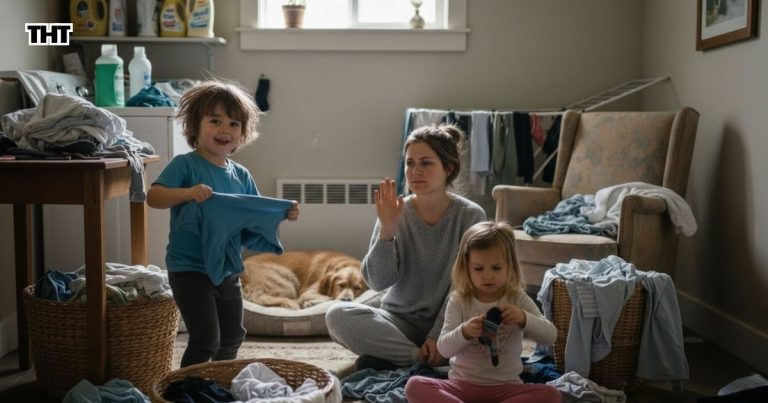
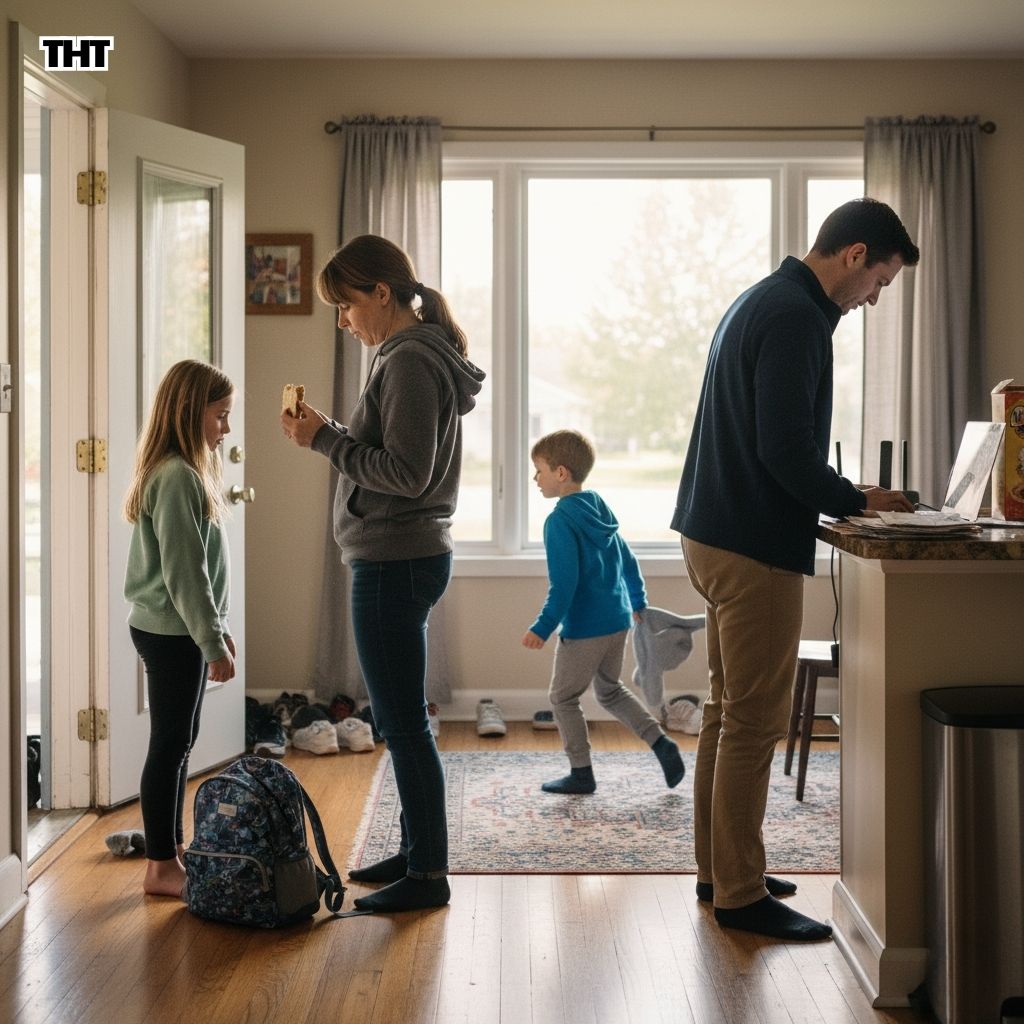
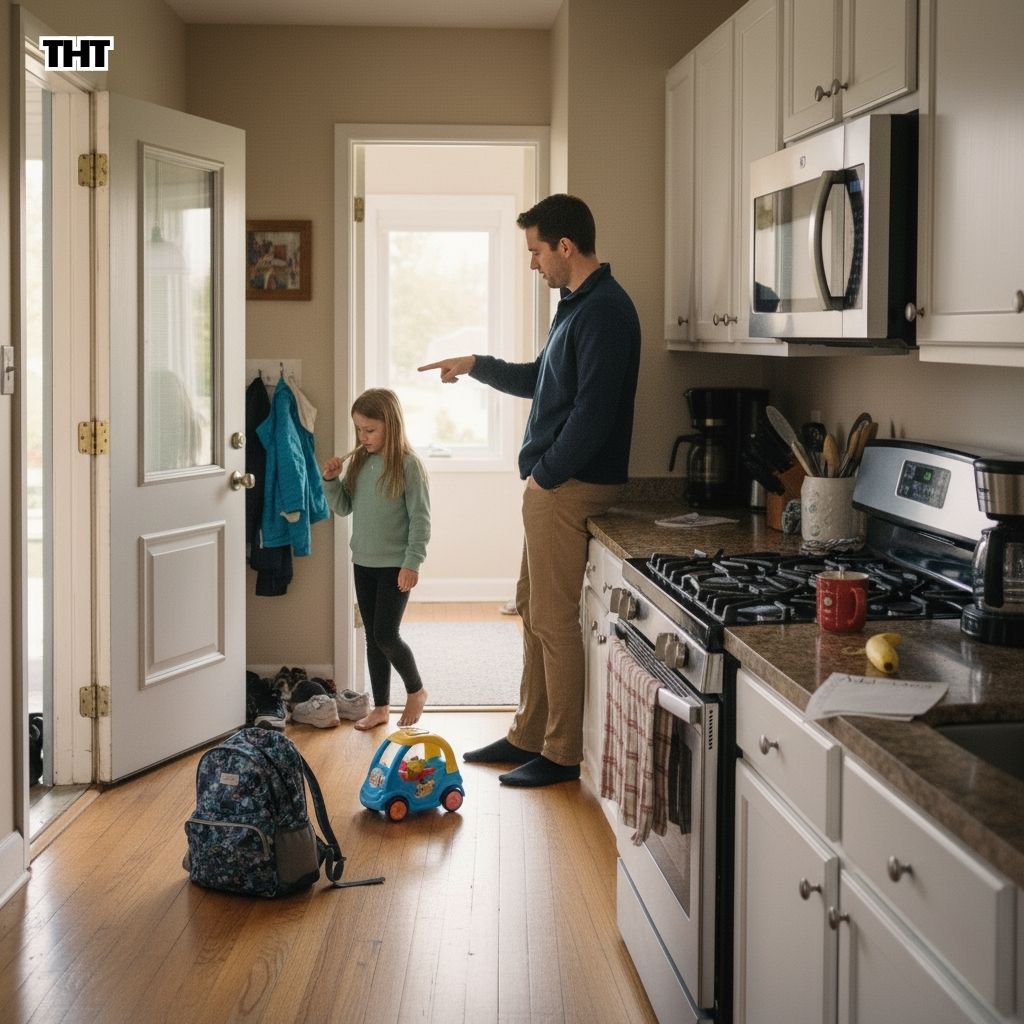
Nora was stuck, staring at her backpack, convinced she forgot something but unable to name what it was. Miles was refusing to put on his shirt because the tag “felt wrong,” which is one of those kid problems that sounds small until you realize it’s actually a sensory and control issue and not something you can solve with “just do it.” Chris was in the kitchen trying to fix the Wi-Fi, because the Wi-Fi always chooses chaos times to act up, and I was standing in the middle of the house holding a piece of toast like it was a microphone, thinking, I cannot start every day like this.
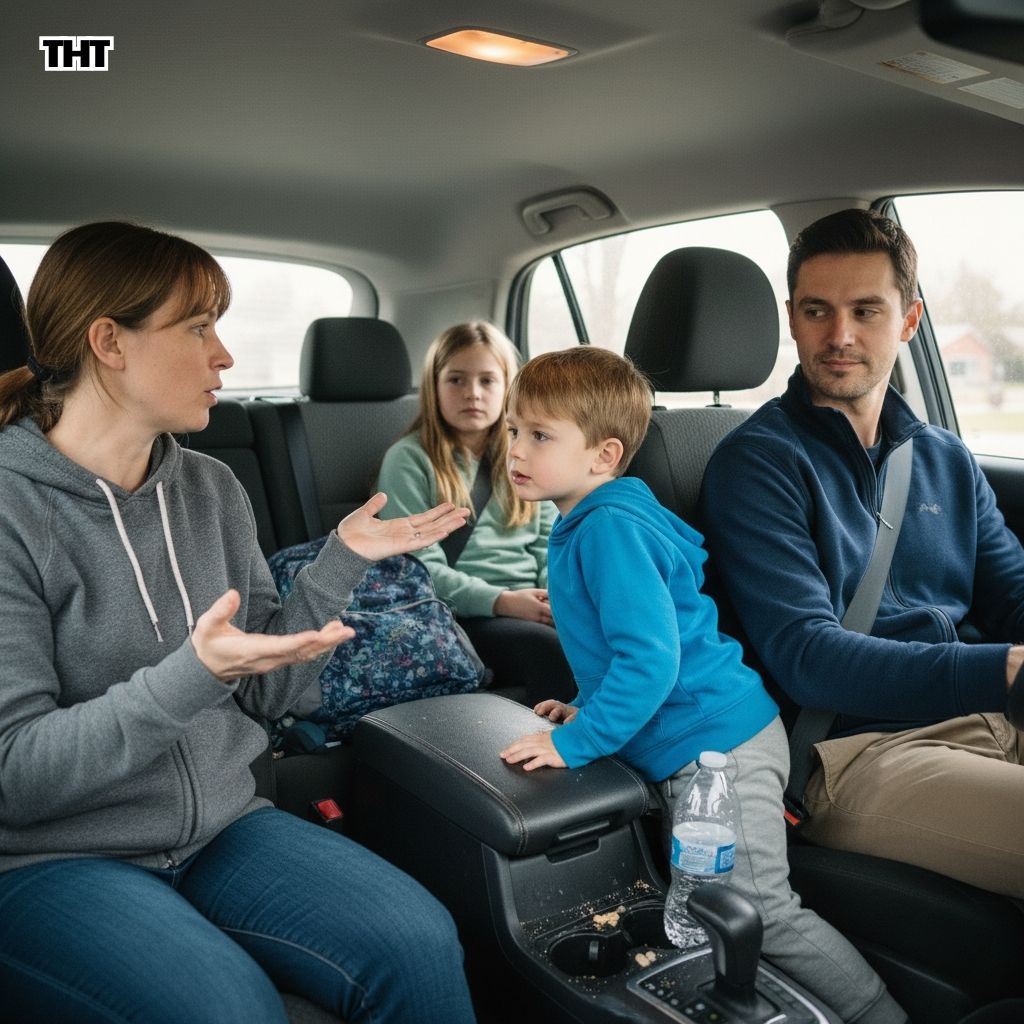
When we got in the car late, Nora was quiet and tense. Miles was loud and upset. I was frustrated with myself, because I kept telling myself a better parent would have figured this out by now, and that thought is a terrible motivator because it doesn’t create solutions, it just creates shame.
That afternoon, during our car check-in, I said, “Okay. We need a different morning routine. The current one is making everyone miserable, including me.”
Nora nodded, relieved that I said it out loud. Miles said, “I don’t like mornings,” as if he had just uncovered a new scientific fact. Chris said, “Let’s simplify it.”
And that word, simplify, turned out to be the doorway.
Why Our Routine Wasn’t Working in the First Place
When I looked at our mornings honestly, I realized we were doing something that seems logical but doesn’t actually help kids.
We were making the routine a series of solo tasks, and then I was acting surprised when my kids didn’t feel motivated to do them quickly.
For Nora, solo tasks can feel heavy, because she starts thinking about doing them “right,” and her anxiety kicks in. For Miles, solo tasks feel boring and controlling, and boredom plus control is basically his personal recipe for resistance. Even Chris and I were doing solo tasks in parallel, and then colliding in the hallway trying to coordinate, which added friction without any sense of teamwork.
We didn’t have an anchor point, something that gathered us together and set the tone before we scattered into separate directions.
We had a list. We didn’t have a rhythm.
So instead of adding more steps, we chose one shared task and built the morning around it.
The Shared Task We Picked, and Why It Worked
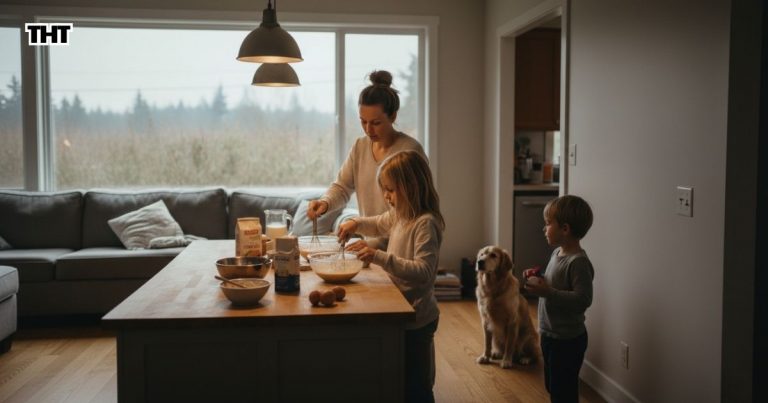
Our shared task became making breakfast together, but not in the “everyone do everything” way that becomes a mess. We made it a simple, repeatable breakfast assembly that took ten minutes and gave each kid a job.
The reason breakfast worked as our anchor is that it’s naturally necessary, it happens at the same time every day, and it’s something kids can do without needing to be perfect. It also sets the tone. If the first interaction of the morning is connection instead of correction, the whole day shifts.
We kept it ridiculously simple on purpose.
We chose one “base” that repeats most days: oatmeal, toast, yogurt, or eggs, depending on the week. We chose a small set of add-ons: fruit, nuts, cinnamon, honey, peanut butter. Then we assigned jobs.
Nora became the “setup person,” because she likes structure. She sets out bowls or plates, puts out spoons, and checks that everyone has what they need. It gives her a calm sense of control that doesn’t turn into perfectionism, because the task is concrete and finite.
Miles became the “picker,” because he loves choice. He chooses the add-on for the day, within a short list. He can pick blueberries or bananas, peanut butter or honey, and his brain lights up because he has ownership. A kid who gets a real choice early in the morning is less likely to fight every choice later.
Chris became the “coffee and timer guy,” because he loves systems and he’s already making coffee anyway. He sets a gentle timer for the breakfast window, and we treat the timer like neutral information, not a threat.
And I became the “cook the base and stay calm” person, which sounds like the smallest job but is actually the hardest one for me, because it requires me to slow down and stop trying to fix everything at once.
We did not add a morning chart. We did not add rewards. We didn’t even call it a routine at first. We simply said, “We’re going to start mornings by making breakfast together, and when breakfast ends, we move into the next steps.”
That was it.
One anchor.
The First Morning It Worked (Not Perfectly, But Noticeably)
The first morning we tried it, I expected pushback, because new routines often trigger kids to test boundaries. Instead, it felt oddly calming, like everyone was grateful for the simplicity.
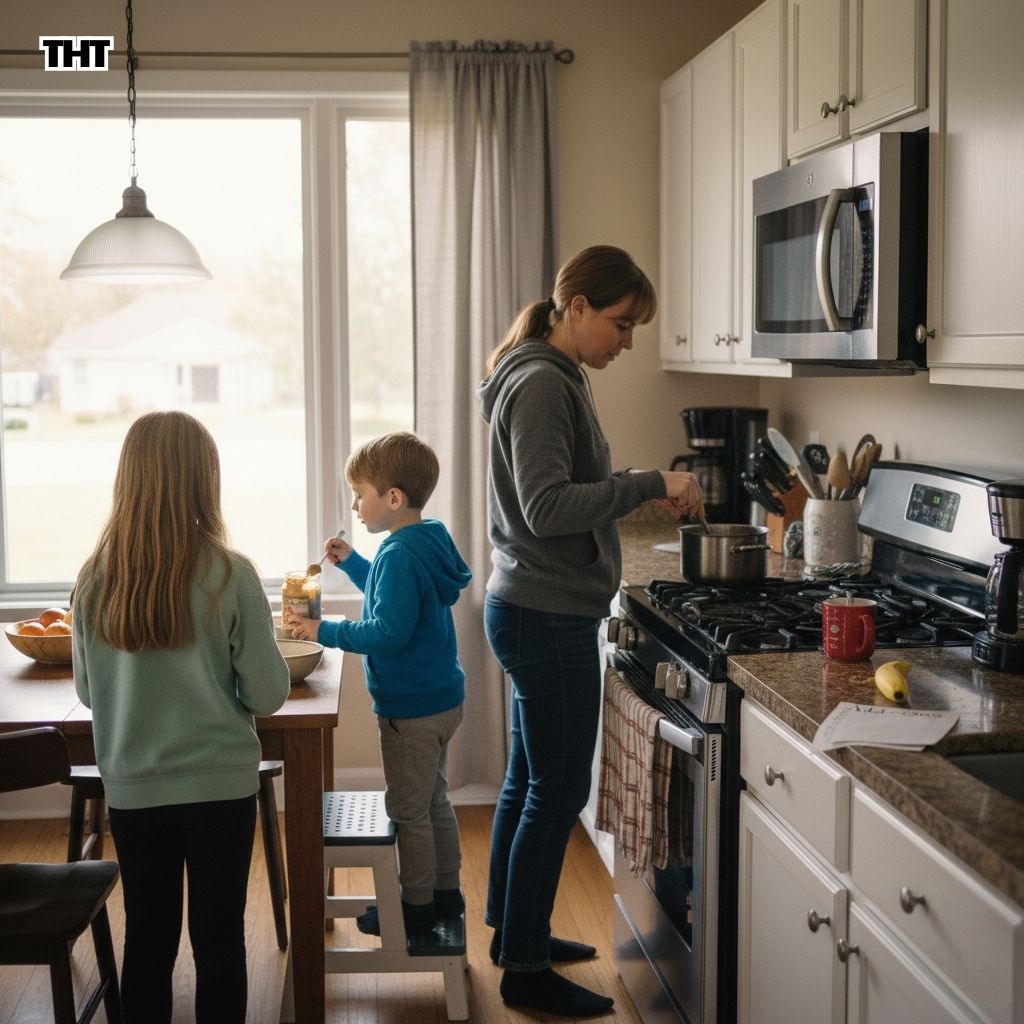
Nora came into the kitchen and started setting out bowls without me asking. She moved with more confidence than usual, because she knew what her job was and she didn’t have to guess what came next.
Miles walked in and immediately asked, “What do I pick?” like he had been waiting his whole life to have an official breakfast decision role.
He chose bananas and peanut butter, and he was so proud of the combo that he announced it like a menu special.
Chris set the timer quietly. I made oatmeal. We sat down for ten minutes, and those ten minutes were not a long, peaceful family breakfast like a movie scene, because Miles still spilled a little and Nora still corrected him and I still had to remind someone to chew with their mouth closed. But the tone was different.
We were together.
Then the timer went off, and Chris said, calmly, “Okay, breakfast window is done. Next step is teeth and backpacks.”
Because the morning started with connection, the transition didn’t feel like a command. It felt like a flow.
Nora moved to brush her teeth without spiraling.
Miles tried to wander off with a toy, and I said, “First teeth, then toy,” and he accepted it more easily than usual, because his cup was already a little fuller.
We still weren’t perfectly on time, but we weren’t angry, and that was a bigger win than the clock.
What It Taught Me About Kids and Cooperation
I used to think cooperation meant kids doing what I said quickly. Now I think cooperation is more like a relationship skill that grows when kids feel safe and included.
That shared breakfast task did a few things at once, without us needing to lecture about it.
It gave Nora predictability, which calms her anxiety. She wasn’t waking up into uncertainty. She was waking up into a role she could handle.
It gave Miles early autonomy, which reduced his need to fight later. When kids get one meaningful choice early, they often stop trying to control everything else.
It gave Chris and me a shared entry point, so the morning didn’t feel like I was the manager and everyone else was reacting to me. It felt like we were a team starting the day together.
And it gave all of us one small moment of connection before the demands of the day began, which matters more than most people realize, especially for kids who can get dysregulated quickly.
Here’s the Part I Messed Up, So You Don’t Have To
At first, I tried to add too many extra tasks onto the shared breakfast, because once something works, my brain immediately wants to optimize it like I’m running a small company.
I thought, we can do breakfast and review the schedule and pack lunches and talk about the day and maybe also practice spelling words, because why not turn breakfast into a productivity seminar?
It was a terrible idea.
The shared task works because it’s simple and emotionally light. When I overloaded it, it started feeling like pressure again, and the magic disappeared.
So I pulled it back.
Breakfast was breakfast. Ten minutes. One job each. Then we moved on.
If you try this, protect the anchor from becoming a lecture or a checklist. Keep it human.
The Routine We Have Now, in Real Life Terms
Our mornings still aren’t quiet. Miles is still Miles. Nora still worries sometimes. I still have days when I feel rushed. But the difference is that we have an entry point that steadies us.
We wake up. We head to the kitchen. We do the shared breakfast task. Then we move into the solo tasks, and because we’ve already had a small moment of connection, the solo tasks feel less like isolation and more like steps in a shared plan.
We also built one small rule around it that helped a lot: we don’t start screens until after we’re fully ready to leave. Not because screens are evil, but because screens are sticky, and mornings already have enough friction. That rule became easier to follow because breakfast gave the kids something to do that felt like participation, not punishment.
Final Thoughts
I used to think a successful routine was built out of perfect habits and strong discipline. Now I think it’s built out of one steady anchor that fits your family’s real personality.
For us, the anchor was a shared breakfast task with clear roles and gentle limits, and it worked because it shifted our mornings from “me managing everyone” to “us doing one thing together and then moving forward.”
It didn’t fix everything. It didn’t make mornings magical. But it did something better than magic.
It made mornings feel possible, and in a family with a sensitive nine-year-old and an energetic six-year-old, “possible” is a gift I will take every day.